

Best Forex Brokers in [year]
[brokers num=”3″ type=”CMA”]
Regulation and licensing under Kenyan law
Forex trading is legal and regulated in Kenya, and the applicable governmental agency that licenses and oversees forex brokers is the Capital Markets Authority (CMA). This matters because it gives locally licensed brokers a legal framework to operate within, including clear rules around client fund protection, reporting standards, and conduct. Brokers regulated by the CMA are required to maintain segregated client accounts, submit regular audit reports, and operate with a certain degree of financial transparency that helps reduce risk for retail traders.
The CMA has developed a reputation for being one of not many regulators in Africa that has a clear and actionable structure in place for overseeing online forex brokers, which puts Kenya in a beneficial position on the continent. Traders using CMA-licensed brokers have legal protection in case of disputes, and local courts can intervene in a useful manner if things go wrong.
Local currency accounts and payment options
Forex brokers operating in Kenya typically offer trading accounts denominated in Kenyan shillings (KES), or will at least allow deposits and withdrawals in KES. This is useful for avoiding conversion fees and unpredictable exchange rate fluctuations that come with using USD-based or EUR-based accounts. It can also simplify funding, especially for traders using mobile money or local bank transfers.
For many forex traders in Kenya, selecting a broker that offers deposits and withdrawals through the local mobile payment method M-Pesa is important. Many brokers with a presence in the Kenyan market allow clients to fund their trading accounts and withdraw profits directly through M-Pesa, thereby bypassing traditional banking delays and giving traders access to instant, low-cost transactions that are widely accessible, even for small-scale hobby traders living outside major urban centers. This kind of mobile-first finance solutions are very important for retail financial services operating in Kenya.
Broker offices in Kenya and in-person support
Online forex brokers are popular in Kenya, but you can also find brick-and-mortar forex brokers with a physical presence in offices in Nairobi and other major cities. Kenyan traders can walk into a local office, speak to staff, attend free training sessions, or resolve issues in person. In a market where trust is a concern and online-only services still feel risky to many people, that local presence carries weight.
This physical presence also allows for in-person education. Brokers may run seminars, classroom-style workshops, or one-on-one onboarding sessions for new traders. These are often offered in Swahili or a mix of Swahili and English, making them more accessible to the broader public.
Taxation and legal considerations
Forex trading profits in Kenya are subject to capital gains tax and may also fall under income tax, depending on the scale and frequency of trading activity. It is a good idea to consult with a professional to fully understand your options and make suitable choices. This can avoid unpleasant surprises down the line.
Locally regulated brokers are more likely to be familiar with Kenyan tax reporting rules and comply with them, and traders using these brokers can expect a cleaner paper trail if they’re audited or asked to prove income sources. Foreign online brokers operating from abroad, and without a Kenyan license, will not report to the Kenya Revenue Authority (KRA), which makes taxation less straightforward and legally riskier.
To comply with AML (anti-money laundering) rules and Know Your Customer (KYC) requirements, many brokers (both in Kenya and abroad) require ID verification, proof of address, and in some cases, bank statements. While this adds friction to the onboarding process, it aligns with Kenyan financial sector reforms meant to reduce fraud, money laundering, and the financing of illegal activities through trading platforms.
Market maturity and local adoption
Kenya is among the fastest-growing retail forex markets in Africa. The trader profile is skewed toward younger, mobile-first users, who start with a very small capital. This has encouraged brokers operating in Kenya to offer low minimum deposit accounts, small minimum trade sizes, mobile-optimized platforms, and a simplified onboarding process. Brokers that serve the local market typically offer micro-lot trading and support for local payment wallets, and sometimes also a lean (but still compliant) account setup with fewer verification delays compared to global brokers targeting more established markets.
What stands out in Kenya is the blend of international structure and local adaptions. While many brokers use platform-types that we recognize from the international sphere, funding via M-Pesa, learning through Swahili WhatsApp groups, and attending seminars at a Nairobi office is very grounded in local culture and behavior. Regulation by the CMA has also helped to both add a layer of formality and oversight that we recognize from more mature markets, while also ensuring that active brokers are more firmly entrenched in the country and within reach for local law enforcement. This mix makes Kenya different from markets where the forex trading sphere is either dominated by huge international online brokers based on the other other side of the world, or rooted in very small, underground operations.
Predictions
Age
As mentioned above, the average forex trader in Kenya is young, but this does not mean that brokers are currently bending over backwards to appeal to older traders and find new clients that way. Even though the Kenyan trader profile is skewed toward younger, there is still a very large untapped market of young people available in Kenya that forex brokers can focus their marketing on, simply because the entire Kenyan population is skewed toward younger. In 2024, the median age of the Kenyan population was slightly below 20 years, while the median age of the U.S. population was slightly below 39 years, and the median age of the European Union population was just below 45 years. Approximately 40% of the Kenyan population was under 15 years old in 2024, while nearly 19% was 15-24 years old. Of roughly 52 million people that were living in Kenya in 2024, almost 74% were under the age of 35. As you can see, brokers active on the Kenyan market are likely to continue focusing their marketing efforts towards young people.
Language
English is the lingua franca of the financial markets, and many of the brokers active on the Kenyan forex market are English-only, or include a smattering of Swahili in their promotional material and/or educational material. We are noticing a growing trend towards Swahili, however, and we might see a stronger presence for this language within the Kenyan forex trading industry in the coming years.
Swahili is the national language of Kenya, but both Swahili and English are recognized official languages. Roughly 70 different languages are spoken in Kenya, and many Kenyans have neither Swahili nor English as their first language, but use one or both of them in their everyday life.
Religion
In 2024, the Muslim population in Kenya was at an estimated 5.6 million, making Islam the second-largest religion in the country, following Christianity. Since Islam has a strong presence in the country, we predict that more forex brokers interested in the Kenyan market will not only offer Sharia-compliant trading accounts but also market this feature more heavily. This might become especially noticeable in the counties of Mandera, Garissa, and Wajir in the North-East region, since they have a higher concentration of Muslims, and in major urban areas.
Finding a good forex broker in Kenya
A good forex broker in Kenya isn’t just offering access to the global forex market, they’re also offering local reliability for Kenyan traders. To avoid jurisdictional complexity, many Kenyan traders opt for a broker that holds a license from the Capital Markets Authority (CMA). Foreign brokers are also accessible online, but using a broker that is based outside Kenya and operating under a foreign license makes the situation more complex from a jurisdictional point of view.
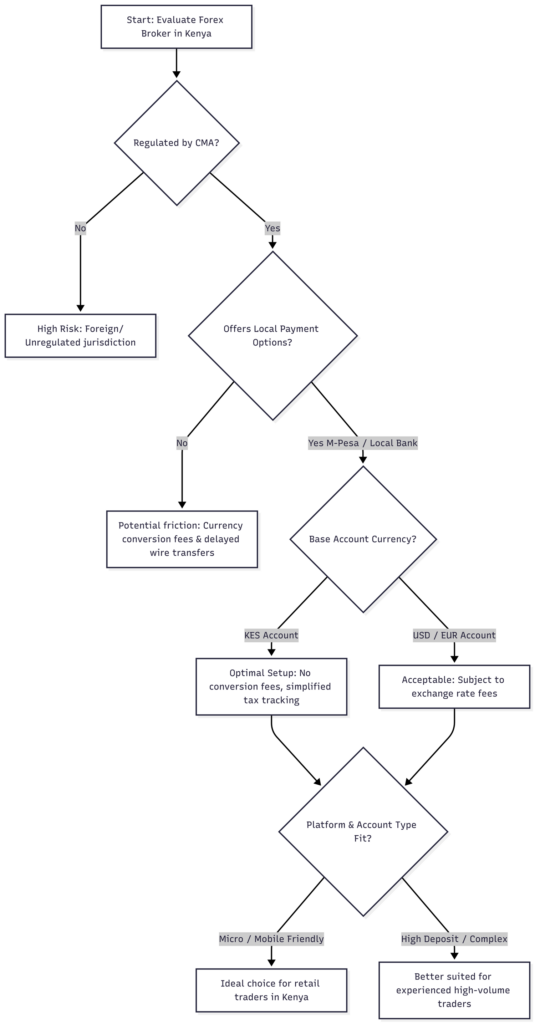
Kenyan brokers, and international brokers that have gone through the trouble of setting up a local company in Kenya and obtained a CMA license, are also more likely to offer things that the average Kenyan trader is looking for, such as the ability to make deposits and withdrawals using M-Pesa, and the option to keep Kenyan shilling (KES) in your trading account instead of having to convert the money to USD or EUR.
The average new Kenyan forex trader is young and is starting out with a very small capital, planning to grow their account balance gradually. The average beginner will be using their mobile phone instead of a computer setup, and want to be able to do everything from the phone: carry out trades, manage their account, make deposits and withdrawal, and access guides and educational material. They also like to have a broker with which they can scale up later, e.g. one that offers both micro accounts and standard accounts, and where the trading platform is suitable for both mobile phone trading and big screen trading. Brokers that take the Kenyan market seriously typically strive to take these wishes into account, e.g. by offering a small-deposit micro account and a good mobile app trading platform, which can be upgraded to a standard account and a computer-compatible setup later on.
CMA regulation
If you’re trading from Kenya and want jurisdictional clarity, start by looking for a broker regulated by the Capital Markets Authority (CMA). CMA-regulated brokers are legally allowed to operate in the country and are supervised by the CMA. Among other things, they are required to separate client funds from company funds, submit audit reports to the CMA, and operate under the CMA rules of fairness and transparency. In short, they’re held accountable. If a dispute happens, there’s an established legal process to follow and the CMA can take the reins. It is much easier for the Kenyan authorities to do something about a company that is based in Kenya and licensed by the CMA, than a broker that is based on the other side of the world and licensed by a lax financial authority that doesn´t really bother much with trader protection.
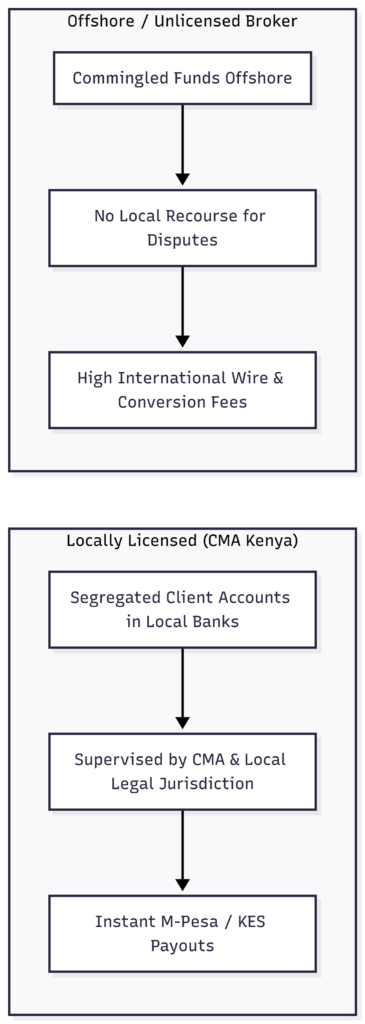
Many brokers without a CMA license still accept Kenyan traders, but it is usually pretty easy for them to ignore Kenyan law.
If a broker claims to be licensed by the CMA, always confirm this directly with the CMA. Any fraudster can lie and claim to be licensed by the CMA, or by some other reputable financial authority. You need to do your own due diligence.
Deposits and withdrawals
Kenya runs on physical cash and mobile money. Therefore, a forex broker that is serious about the Kenyan market will normally accept M-Pesa for both deposits and withdrawals, since this is the dominating transaction system for ordinary consumers in Kenya.
If you want to use M-Pesa, make sure the broker accepts both deposits and withdrawals without complicated workarounds. This isn’t just about convenience, it is also about speed and safety. M-Pesa lets you move funds instantly, with low transaction costs and no need for a traditional bank account. It makes it easy to manage small deposits and withdrawals, which is important for most novice forex traders. If M-Pesa transactions are accepted, but only through workarounds and third-party solutions, it increases risk.
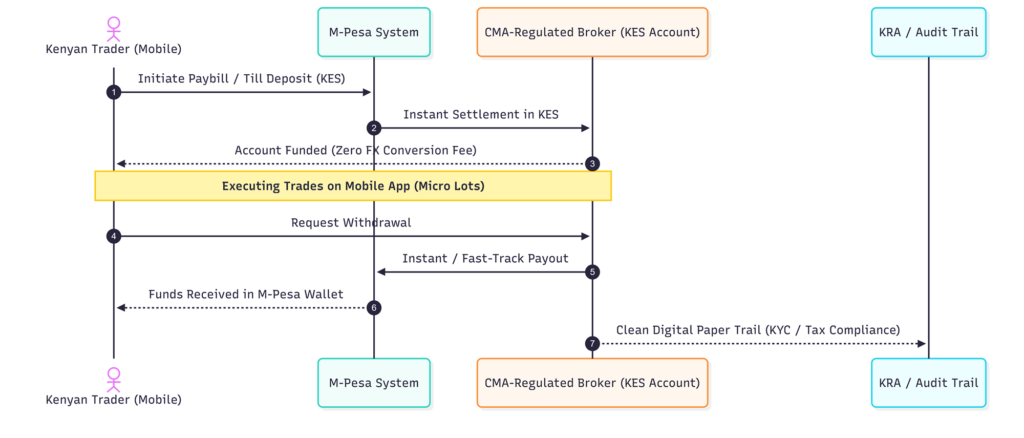
Look for brokers that process M-Pesa withdrawals quickly, without excessive delays or lengthy manual approval steps. If withdrawals are limited to bank transfers or if withdrawal requests take more than 48 hours to process by the broker, you’re probably dealing with either offshore delays or internal inefficiencies. Brokers operating from inside Kenya, with CMA approval, should be able to provide fast and reliable withdrawals for traders in Kenya. If they can´t, consider that a warning sign.
KES support
A broker that accepts Kenyan shillings (KES) for deposits and withdrawals, and also offers KES-denominated accounts, is a big plus for many traders in Kenya. It means fewer conversion fees, more transparent profits and losses, and easier tracking for both personal and tax purposes. If the rest of your life runs on KES, a KES account gives you a better feel for over how much you’re really putting at risk, without having to constantly calculate currency exposure against USD or EUR.
Transparency around costs
A broker should be clear about costs and fees, such as spreads, commissions, deposit fees, withdrawal fees, platform fees, and overnight charges. If you have to dig through four pages of terms and conditions to figure out how much it costs to take out your own money, that’s a problem.
Account types and trade flexibility
If you are a novice trader, it is a good idea to start out small, and that is true even if you have saved up and could make bigger trades. Start with small trades, and do not increase the size until you have gained more skills and experience, and have been consistently profitable over time.
Because of this, it is good to look for brokers that offer micro accounts or even nano accounts. These accounts allow you to open positions with minimal capital exposure and give you space to make mistakes, or simply have the market move against you, without blowing a lot of money. High minimum deposit requirements are usually a red flag, especially if the broker is simultaneously marketing itself as beginner-friendly. Reputable brokers with high minimum deposit requirements will typically focus on more experienced traders.
Platform and order execution
You don´t have to start with a minimalist trading platform designed specifically for beginners, but it is important that the platform does not overwhelm you. Even an advanced and feature-heavy trading platform can be designed in a way that makes it fairly easy to focus on the core features and ignore the rest as you start out.
Look for clean order entry, charting that works, and fast execution during both active and low-volume hours. A good broker will make sure their servers are stable during market spikes, particularly during high-impact events like U.S. interest rate announcements. If your platform crashes or freezes the moment something important happens, the spreads don’t matter. Execution reliability is part of the package, and if it’s not there, you’re not getting what you need, even if everything else looks good on paper.
Leverage
Check whether the broker supports flexible leverage, preferably starting really low. You don’t need 1:1000 leverage as a beginner and overuse of leverage is a quick path to overtrading, margin calls, and wiping out the account balance.
A responsible broker won’t push aggressive leverage. A broker that seems eager to encourage beginner traders to take on a lot of leverage probably has a short-term focus on bringing in deposits rather than a long-term focus on cultivating the success of its clients over time.
A serious broker with a sound business model is most likely making the bulk of its money from spreads and/or commissions. This broker want you to succeed and remain a prosperous client for the rest of your life, continuously providing the broker with revenue each month. When a broker is downplaying risk and seems obsessed with draining your bank account as quickly as possible through high-risk leveraged trading and hasty deposits, something is off.
Customer support
Customer service isn’t just about answering questions, it’s about answering them in a way that is actually useful and makes sense in your context. A broker that offers support in both English and Swahili, depending on the needs of the client, can help cut down miscommunication and make the overall experience smoother.
Make sure you can get real-time support in a convenient way, e.g. through live chat, WhatsApp, or a local phone number. An international toll free number that can be reached from Kenya can also work well. Avoid brokers that require you to pay for an expensive phone call to another country.
Support teams that understand local payment systems, local banks, and common ID documents make account setup faster and reduce the chance of account rejections over something as basic as the format of a utility bill. If a broker asks you to send notarized documents for a $20 micro account, that’s not someone built for the local market.
Physical presence in Kenya
Some brokers in Kenya are not just available online, they have a physical presence too. If this is important for you or not is something you need to decide for yourself. You also need to decide if it is important for you to be able to attend in-person training seminars, workshops, and onboarding sessions in Nairobi or other urban centers. For some traders, in person events are really helpful for getting started, learning how to use the platform, or resolving issues. For others, especially traders who live far away from the training offices, or are juggling a busy schedule, online training is preferable.