Author

Securities Law Expert
Find the Best Forex Trading Platform


Compared to countries such as Nigeria and Kenya, retail forex trading is still more of a small niche activity in Ghana. With that said, it is a pretty fast growing niche, despite not being properly regulated within the country. In recent years, retail forex trading has gained noticeable visibility in Ghana, particularly among young people, students, and digitally connected professionals. Its presence has become increasingly visible, especially online, where trading culture and related content are widely shared. Yet, retail forex trading it still only something that a very small portion of the total population in Ghana is actively engaged in.
In terms of growth, the trend over the past decade has been clearly upward. Before the mid-2010s, retail forex trading was almost nonexistent in Ghana’s public consciousness, but the 2020s have seen a surge in interest. This rise has been driven largely by increased internet access, the widespread availability of smartphones, and the entry of international trading platforms that allow individuals to participate with relatively small amounts of capital. Social media has played a particularly important role, amplifying awareness and shaping perceptions of forex trading as an accessible path to income.
The economical backdrop matters. Ghana has spent the past few years moving out of a severe macro and debt crisis, and the cedi (GHS ) has seen periods of increased strength followed by renewed pressure from corporate dollar demand. Reuters reported in early 2026 that the cedi had traded around 10.8 to 11.0 per U.S. dollar in several weekly updates, with energy and construction demand remaining an important driver of FX pressure. In Ghana, macro conditions and currency fluctuations are not abstract background noise, it is something that the mainstream population is very much aware of, and this in turn helps boost a curiosity for currency speculation.
The official Ghana FX market is regulated and supervised, but the retail online industry is not. The platforms that individuals use are typically foreign and operationally separate from that domestic legal structure. A retail fx trader in Ghana does not have much legal recourse if a foreign based platform suddenly freeze their account or manipulate price feeds. This risk must be taken into account if an individual still decides to risk their money on fx trading. Use a credible broker, keep leverage low, and understand that funding and withdrawals are part of the risk. You also need to make sure you understand how relevant tax regulations work.
Retail forex trading in Ghana is possible, but the environment is not as safe as it is for traders based in countries with a more mature legal situation for retail fx traders. Despite this, economic conditions, especially youth unemployment and underemployment, is pushing many people in Ghana to explore alternative income sources, and forex trading online is a flexible opportunity that requires a relatively small initial investment. At the same time, social media influencers and self-styled trading mentors have contributed to its popularity by promoting success stories and aspirational lifestyles. The low barrier to entry, requiring little more than a smartphone, and internet connection, further adds to its appeal. There is also a broader trend of increasing financial awareness in Ghana, with more individuals becoming curious about global markets, investing, and digital finance.
The lack of strong national regulation of retail forex trading online remains a strong reason why forex trading has not become more widespread in Ghana, and why so many of those who do give it a try fall into the clutches of scammers or low-quality brokers. The situation is contributing to well-founded skepticism among the general public. The association of forex with scams, Ponzi schemes, and misleading “get rich quick” narratives has damaged trust, and many Ghanaians continue to favor more familiar and tangible income-generating activities.
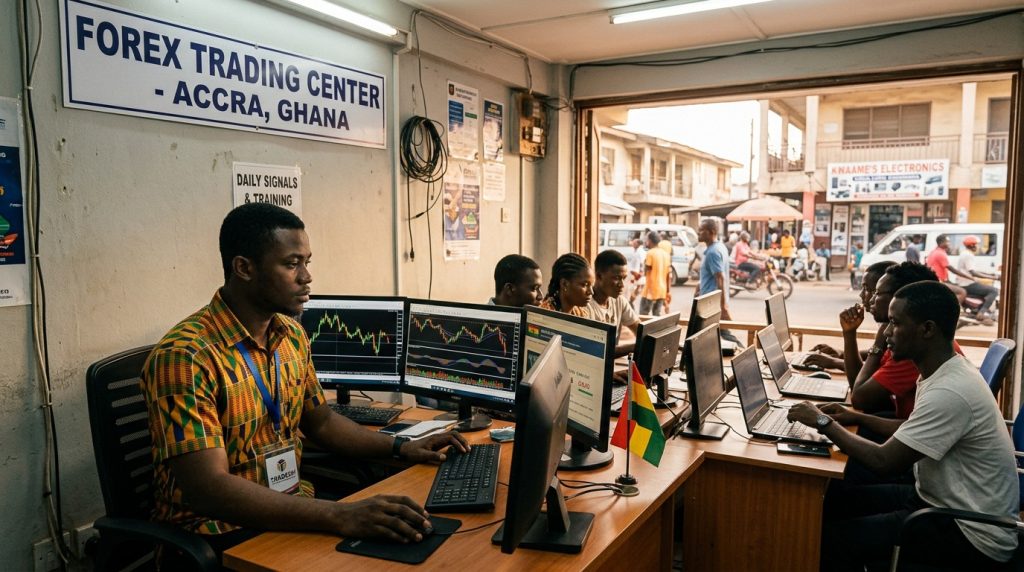
Ghana has an active official forex framework run by the Bank of Ghana, including annual approval requirements for local and international FX brokers that want to operate in Ghana’s forex market. At the same time, there is no legal framework in place for forex brokerage company that wants to offer online retail forex trading.
A retail forex broker cannot currently be licensed and supervised by any governmental authority
in Ghana. Ghana’s retail forex space exists in what is best described as a regulatory gap or gray zone. Retail forex trading is not illegal, but there is also no specific licensing framework in place for retail forex brokers, and no company can obtain a local license to offer online retail FX trading to the public. As a result, there are effectively zero locally licensed retail forex brokers available.
Retail forex traders in Ghana are therefore using foreign forex brokers, even though this introduces jurisdictional complexity. Many pick globally well-known brands and aim to be onboarded by a company supervised by a strict financial authority such as the UK FCA, ASIC in Australia, or one of the European Union membership countries. In reality, may of the globally well-known brands will onboard Ghanian clients through a subsidiary based in a less strict jurisdiction, e.g. the Seychelles. If you are a trader in Ghana, it is very important that you check exactly who your counterpart is before you sign any contract. Sometimes, the nudge from the heavily advertised company licensed by a top-tier financial authority to a company based in the Seychelles, Mauritius, or Belize can be really smooth and difficult to notice unless you are paying close attention.
It is also important to remember, that even if you do onboard through a company licensed by a top-tier regulator, you might not receive the same legal protection as traders who are actually living in that jurisdiction. It can also be difficult or outright impossible for you to get compensation from the governmental investor protection fund that covers domestic traders if the brokerage company becomes insolvent and fails to repay the traders.
This is where confusion happens. The Bank of Ghana, which is Ghana´s Central Bank, does license/authorize FX brokers, but for a completely different market. These licensed brokers operate in the interbank forex market (banks and other institutional traders). They must get annual approval from the Bank of Ghana to participate. In 2026, about a dozen forex brokers in Ghana were authorized to operate in this institutional market. This law does not cover the type of brokers that offer retail trading platforms online.
Ghana´s Securities and Exchange Commission is working on a licensing systems for online retail brokers, but the discussion has been going on for several years and there is no final product in sight. As of 2026, there are is finalized framework and no licenses can be issued. If a retail broker or platform claims to hold a Ghana SEC license, that in itself is a red flag.
Ghana currently has a two-track system:
Retail forex trading is unregulated and no governmental entity is licensing and supervising brokerage companies. There is no investor protection framework in place for retail fx traders. The risk of being scammed or find yourself without recourse in case of a dispute is high.
Retail traders in Ghana access forex through foreign-based online brokers and not through Ghana’s domestic interbank market, since the interbank market is for institutional traders and investors. The retail market rely on foreign brokerage companies, global trading software, and international payment rails. That is common in many African countries and not unique to Ghana.
Make sure you understand exactly which company (not just brand) you are signing up with. You need to know where the broker is regulated, and which rules that pertain to your account when it comes to things such as conflict resolution, client money treatment, negative balance protection, risk disclosures, maximum leverage, KYC, and withdrawals. If those points are fuzzy, it is cause for concern.
It is important that your trading strategy and the broker are suitable for each other, e.g. when it comes to available fx pairs, execution, spreads, commissions, and other costs. Inexperienced traders often focus on welcome bonuses and leverage, but that is not a good way to pick a broker. In reality, things such as poor execution and inconsistent withdrawal rules do more long term damage to retail accounts than the absence of 1:1000 leverage.
Deposits and withdrawals are a necessity, and this can get both risky and costly. A trader may have a decent strategy and still run into trouble if deposits are slow, withdrawals are delayed, or the broker changes withdrawal rules when you try to make a larger withdrawal. The risk of running into this type of friction gets higher when the broker is based in a jurisdiction with lax trader protection.
Before you sign up, make sure the broker accepts both deposits and withdrawals using a method you are comfortable with, and that wont be exorbitantly expensive to use. Also check the broker´s own fees for processing deposits and withdrawals.
Many brokers have thresholds for how small a deposit and a withdrawal can be, respectively. This is also something to consider before you sign up.
Account currency is another practical issue. Example: If the account is denominated in USD while the trader deposits and withdraw in GHS, then every deposit and withdrawal introduces conversion decisions. That is manageable, but it needs to be treated as part of the trading setup, not as an afterthought. Traders who ignore this sometimes think their system is the problem when part of the pressure is simply coming from funding friction and exchange conversion.
The cedi (GHS) exchange rate matters even when the trader is not trading GHS pairs directly. Local income and deposits are often in GHS, while trading balances are usually in U.S. dollars or another major currency. That creates a second layer of risk. A trader can be correct on a forex trade and still feel pressure from conversion costs, funding friction or local currency weakness when moving money in and out.
Retail forex brokers that accept clients from Ghana will typically accept deposits and withdrawal through a variety of e-wallets (Skrill, Neteller), bank transfers, major cards (VISA, MasterCard), and mobile money. Some also accept crypto currency transfers.
Mobile Money transfers is the dominant method for small-scale retail traders in Ghana. Examples of available methods are MTN Mobile Money, Vodafone Cash, and AirtelTigo Money.
Mobile Money has become popular since it works directly from a phone, facilitates quick deposits, and have very small minimum amounts. (But you also need to check the minimum amounts accepted by the broker for deposits and withdrawals.)
Most brokers targeting Ghana integrate it through local payment aggregators or P2P systems. For example, both Exness and OctaFX accepts MTN MoMo transactions for clients in Ghana.
Bank transfers are less popular for small traders, but still used for larger transactions. Can be slower (1-3 bank days) and require more compliance checks, especially if the amount is big.
Common banks used:
Transactions through the major cards VISA and MasterCard are widely supported by international brokers. Deposits and usually quicker than withdrawals, and withdrawals can take 2-5 bank days.
E-wallets are common in Ghana’s more advanced retail trader segment. Examples of commonly used e-wallets are Skrill and Neteller. They provide fast transfers. Sometimes it will be difficult to withdraw from e-wallet to Ghana banks due to restrictions.
Cryptocurrency transfers are becoming more common, especially among younger traders. It is very fast and low friction. Make sure you understand the specific risks associated with cryptocurrency before you proceed.
Not always official, but very common in practice. This segment includes local broker “agents” on the ground in Ghana, WhatsApp/Telegram funding networks, and USDT ↔ mobile money conversion systems. They help bridge gap between crypto, e-wallets, and MoMo, and are typically used when more direct rails are limited.
Peer-to-peer (P2P) funding in Ghana’s forex and crypto ecosystem exists because the formal banking system is not fully designed to support retail trading flows to offshore brokers or digital asset platforms. Since the financial system regulated by the Bank of Ghana is focused on banks, licensed dealers, and official foreign exchange channels, traders often rely on informal intermediaries to move money between mobile money, crypto, and trading accounts.
In practice, P2P systems usually work through individuals or small groups sometimes called “agents” or “funding handlers.” These are people who connect buyers and sellers of digital value. For example, a trader may send Ghanaian cedi through MTN Mobile Money to an agent, and the agent will then credit the trader’s forex account using USDT, Skrill, or another funding method. The reverse also happens when a trader wants to withdraw profits; the agent receives funds from the broker or crypto network and sends mobile money back to the trader. Increasingly, this also happens through WhatsApp or Telegram groups where exchange rates and settlement instructions are coordinated manually.
Many global forex brokers do not have fully direct, stable banking integrations with Ghanaian banks, and even when they do, card and bank transfer restrictions can make funding inconsistent. At the same time, mobile money is domestic and easy to use, but may not connect directly to global brokerage accounts or crypto systems. P2P therefore acts as a bridge layer that converts between these different financial worlds: mobile money on one side and international trading infrastructure on the other.
These system come with significant counterparty risk and regulatory risk. Agents largely operate outside formal supervision and access to recourse is weak when disputes arise. Exchange rates in P2P markets are not standardized, so traders may receive worse rates than official or broker-provided channels. There can also be delays, liquidity shortages, or sudden changes in availability, especially during periods of high demand.
The Bank of Ghana regulates foreign exchange flows at the banking level to manage capital outflow and currency stability (cedi protection), and banks can block transactions due to a variety of reasons.
Whether a payment method gets blocked for forex trading depends less on the broker and more on how the country’s financial system classifies and controls different types of transactions. The key point is that bank transactions, and bank cards such as Visa and Mastercard, are the most likely to be blocked or fail because they operate through the formal banking system. When a Ghanaian uses a debit or credit card, the transaction passes through the issuing bank, and that bank applies foreign exchange rules, risk filters, and merchant category restrictions. Forex brokers are usually classified as high-risk investment or speculative merchants, which makes banks cautious. On top of that, Ghanaian banks are subject to FX controls and internal compliance policies designed to limit capital outflows and manage exposure to offshore financial services. As a result, even if the broker accepts cards and bank transfers, the local bank in Ghana can still decline transactions.
Compared to cards, bank transfers are less likely to be blocked instantly. Instead, they are slowed, questioned, and eventually rejected. Banks may request proof of purpose or reject transfers they classify as speculative or unrelated to approved FX uses. Because bank transfers are fully visible within the formal financial system, they attract a lot of scrutiny.
Mobile money behaves differently because it is domestic and operates inside Ghana’s own payment ecosystem. This makes it less exposed to cross-border FX restrictions. Instead of being blocked, mobile money transactions are more likely to face limits such as daily caps, wallet restrictions, or temporary payment channel disruptions. In most cases, if a forex deposit via mobile money fails, it is due to operational limits or payment gateway issues rather than regulatory blocking of the broker itself. This has contributed to making mobile money a dominant method for retail forex traders in Ghana.
The underlying reason all of this happens is that Ghana maintains a controlled foreign exchange environment where the official system is designed for banks and regulated institutions, not for individual retail trading of global derivatives. Retail forex trading exists in a regulatory grey zone, so payments are not explicitly designed for it. Instead, traders rely on whichever channels can bypass or fit within existing rules, and each method carries a different level of friction depending on how closely it is tied to the formal banking system. In simple terms, the more a payment method passes through traditional banking infrastructure, the more likely it is to be blocked or restricted for forex-related activity. The more it stays within domestic or alternative payment systems, the more likely it is to work smoothly, even if it still has operational limits.
Forex trading in Ghana is often sold online as a way to “beat the cedi” and earn big money from home with the help of a small deposit and big leverage. That pitch leaves out how big leverage can destroy an account in the blink of an eye. When a position is heavily leveraged, a trader does not need to be wrong by much to be ruined.
That point is sharper in a market like Ghana, where macro headlines can tempt traders into oversimplified positions. If the cedi looks weak against the USD, the instinct is to buy USD aggressively. If inflation looks better, the instinct flips. Reuters reported in early April 2026 that Ghana’s inflation had slowed for a 15th straight month, while separate Reuters FX reports still showed the cedi under pressure from periodic hard currency demand. That is a useful reminder that macro stories do not move in one clean line. Lower inflation does not eliminate FX volatility, and corporate dollar demand does not create a clear trade every week.
There is also a structural temptation for Ghana based traders to overfocus on USD/GHS as a macro story and underfocus on global drivers. Most retail forex volume still sits in the major pairs, and those pairs move on U.S. rates, global risk appetite, European data, Japanese policy and commodity flows as much as on anything local. A trader in Accra is not insulated from Federal Reserve pricing.
It is also good to keep in mind that Ghana’s recent FX framework changes, official warnings on unauthorized activity, and efforts to tighten formal FX channels all suggest a system that is becoming more supervised, not less. Traders should assume that compliance, source of funds, transaction visibility and proper use of authorized channels will matter more over time, not less.
The dry version is that forex trading is difficult and risky everywhere, and Ghana adds its own practical friction through currency conversion risk, limited payment rails, and regulatory ambiguity around foreign retail access. None of that makes trading impossible. It just means the margin for sloppy decisions is thinner than social media makes it look.
Scams remain a major problem in Ghana, as they do elsewhere. The situation tend to be worse in countries, such as Ghana, where traders can not access locally licensed and tightly supervised brokers. When fraudsters know that retail traders must seek out foreign entities that are more difficult to investigate, they take advantage.
With many forex scams, the pattern is eerily familiar across the globe. “Guaranteed” returns, account management promises, signal packages, incorrect license claims, and pressure to deposit quickly. It is advisable for any prospective forex trader to study common trading scams and learn how to spot the red flags.
The biggest retail forex brands in Ghana belong to globally active and multi-licensed company groups. None of these brands have a legal presence in Ghana, since there is no legal framework available under which they could apply for a license. They are well-known brands and licensed by several different regulators around the world, including both top-tier financial authorities and more lax jurisdictions. Typically, traders in Ghana will not be onboarded under top-tier licenses, such as the UK FCA or ASIC, so this is something you need to keep an eye on. Traders signing up from Ghana will usually be nudged to subsidiaries based in places such as the Seychelles, Mauritius, Belize, or Saint Vincent and the Grenadines.
Examples of popular brands among forex traders in Ghana:
Ghanaian users are usually onboarded under the Seychelles entity, which means trader protection rules are lax and traders can enjoy very high leverage.
Strong African focus. Ghanaian clients are typically oboarded under entities outside Europe, such as Mauritius. Mauritius is not considered a top-tier regulator when it comes to trader protection, but not bottom-tier either. It is a mid-tier regulator.
HFM does have a Kenyan and a South African license, but those does not apply to Ghanaian users. Ghanian users are typically registered with one of the offshore jurisdictions, which means trader protection rules are lax and traders can enjoy very high leverage.
Ghanaian traders are usually placed under the Belize entity, which means trader protection rules are lax and traders can enjoy a very high leverage.
Ghanaian clients are typically served via Pepperstone Markets Limited (SCB) in Bahamas, which means trader protection rules are lax and traders can enjoy very high leverage.
Most African clients, including those in Ghana, are onboarded via the Seychelles entity. which means trader protection rules are lax and traders can enjoy a very high leverage.
Ghanaian users are almost always under the Belize license, which means trader protection rules are lax and traders can enjoy a very high leverage.