A forex demo account is a simulated trading environment, supplied by brokers and trading platforms, that replicates trading screens, order entry workflows and, to a greater or lesser degree, market data. The intent is straightforward: let you learn platform mechanics, practice order entry, and test ideas without risking real capital.
That simple description, however, hides a complex trade-off. Demo accounts vary widely in their fidelity to live markets. The differences are operational (how orders are filled and whether partial fills occur), informational (what data feeds are used and how timestamps are handled), psychological (the emotional stakes are zero in a demo, which changes behavior), and commercial (brokers may design demos to favor conversion to funded accounts). For a trader or investor, understanding these dimensions is essential.
The purpose of this article is not to evangelize demo accounts nor to declare them useless. Instead, we will look at what demo accounts actually do, how they are implemented, how they can vary between different brokers, how they can be helpful, and where they can cause misunderstandings. A disciplined and well-informed trader can use them as a helpful, rigorous step in validating strategies and the choice of trading platform.
What is a forex demo account?
A demo account is a controlled simulation of a trading account. Typically, you will get play-money which can be used to simulate trades on the platform. A good demo account will allow you to interact with the same (or nearly the same) front end as real-money traders.
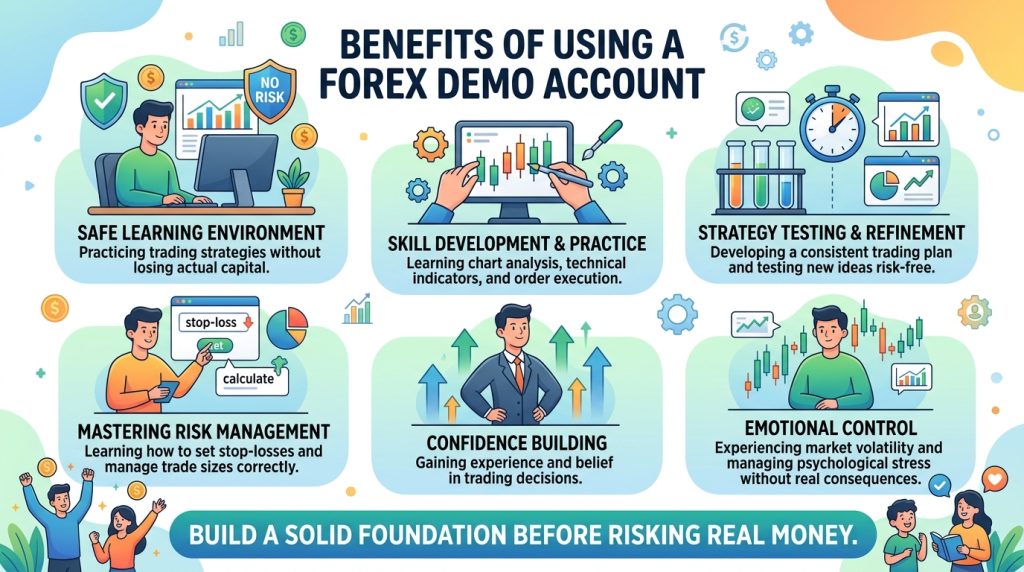
Conceptually, the demo account it serves several overlapping functions. It is an educational sandbox for beginners to learn how to place orders, set stops, and use leverage without suffering capital loss. Even if you have previous experience, it is good to learn how this particular interface works without putting any real money on the line. It will also allow you to evaluate if the interface aligns with your needs and preferences.
A demo account is also an operational testbed for traders who want to explore and confirm various platform features, e.g. execution workflows, integration with charting tools, and indicators. Seeing how the platform works with real-time price feeds is invaluable.
Some traders utilize demo accounts as a place to develop muscle memory. Use the demo account for your exact strategy, and you will learn how to enter orders quickly, how to manage positions, how to read margin notifications, etcetera. For discretionary traders this is useful because efficiency in order entry and discipline in stop placement are skills that benefit from repetition. For systematic traders and developers, demo accounts offer a route to test algorithmic systems, although some demo accounts are devoid of lag and slippage.
The broker´s rules for demo accounts matters. Reputable brokers tend to be generous with their demo accounts, and will happily give you one without demanding a full sign-up process or first deposit. The demo account functions as a marketing and conversion tool, and reputable brokers are eager to show off their offerings. Demo accounts lower the barrier to entry and allow potential customers to habituate to a platform’s ergonomics before making a funding decision. Many brokers allow demo accounts indefinitely with no expiry, which is convenient for testing. Others restrict the demo period and present persistent nudges to fund a live account. Those commercial dynamics shape how traders use demos and how quickly they transition to live trading. If a broker demand a full sign-up or even a first deposit to even grant you access to the demo account in the first place, take it as a warning sign.
How demo accounts work
From a technical perspective, a demo account is a parallel software instance run against a data source. In the simplest implementations, the platform pipes the same live feed used for real money accounts into a simulation layer that records user orders, computes fills based on a model, and adjusts a notional cash balance and position ledger.
However, the conceptual simplicity of a demo account can masks design choices firms make. How closely will the simulated execution mirror real fills? Is the demo price feed is delayed? How will the platform charge, or hide, funding costs? Is margin enforcement faithful to live behavior? A clear, practical approach recognizes demo accounts as one step along the evaluation process. They are useful, but not enough for a complete evaluation. They can help a lot with platform fluency and initial sanity checks, but they cannot be the only evidence relied upon to determine that a broker is high-quality, that it is time to scale capital, or that your trading strategy edge is robust.
Among other things, a good simulation needs to perform basic ledger operations, such as marking positions to market, applying financing charges for leveraged instruments, handling corporate actions for certain financial products, and calculating realized and unrealized profits and losses. It must also present the same user interactions, including margin calls, stop orders, order modification and cancellation, and reporting exports.
Some demo account setups may intentionally use different feeds or different order matching rules. They may rebroadcast a consolidated feed with synthetic liquidity, or they may time-shift historical ticks to ensure deterministic replays. Market-data source is a very important aspect of the demo account. If the demo uses a high-quality, low-latency feed identical to the live environment, it will present near-real-time price movements and spreads. If the feed is delayed or sampled at lower granularity, the opportunity set for quick scalps or precise entry timing will be materially different.
The fill and execution model is also of imperative importance. Some demos assume immediate fills at requested prices, others emulate slippage by applying an algorithmic fill model or by sampling from a historical distribution. Many demos do not emulate partial fills, requotes, or the order queuing you encounter when liquidity thins in a real-money environment. Demos that make you feel successful by giving idealised fills are psychologically satisfying, but may encourage behaviors that fail when facing the real market. On the other hand, overly conservative demos that mimic worst-case fills may discourage otherwise valid strategies. A thoughtful trader needs to know which approach their chosen demo uses and must calibrate their expectations accordingly.
Beyond the points mentioned above, a good demo mode should also emulate ancillary mechanics that change profits and losses, such as overnight rollover or swap calculations for leveraged FX and margins that reflect exchange or broker policy. Differences in rollover conventions or margin multipliers can turn a superficially profitable demo strategy into a money-losing live strategy once the true costs are included.
Types of demo accounts and common features
Most demo accounts fall into a one of a few broad operational categories determined by fidelity and purpose.
- One category is the learning-sandbox demo that prioritizes user experience and confidentiality. It provides a stable, immediate-fill environment to teach order entry and platform navigation.
- Another category is the strategy-sandbox demo that emphasizes data fidelity and may provide tick-level historical replay capabilities so a developer can step through the evolution of signals.
- A third category is the marketing demo with simplified fills and artificially tight spreads designed to highlight the platform’s speed and to lower friction toward sign-up. These demos are particularly optimistic and are known for creating unrealistic expectations.
Typical features across demos include an adjustable notional balance, the ability to place common order types, historical trade reporting, and often an API or scripting interface in platforms geared to systematic traders. More sophisticated demos expose risk parameters, allow toggling between different slippage models, or provide multi-account orchestration for testing portfolio-level strategies. Some platforms also provide sandboxed endpoints for algorithmic order routing that simulate typical rounding errors, partial fills and cancellation race conditions. Recognizing which type of demo you are using is essential, since the feature set and fidelity determine what you can validly test. If your goal is to validate an intraday scalping strategy, you need a demo that provides tick-level data and a realistic fill engine, not a learning-sandbox that only updates prices every few seconds and assumes instant fills.
Practical benefits of using a demo account
How beneficial a demo account can be partly depends on how closely it resembles real-money trading with this broker and on this platform, both when it comes to the interface itself and for factors such as execution speed, slippage, and costs. A well-constructed demo does several practical jobs well. First, it reduces operational errors by allowing traders to rehearse order workflows without the dread of real financial loss. Mistakes in stop placement, using the wrong order type, or misreading leverage effects can be costly in live accounts, and the demo provides a safe space to learn correct routines. Second, a demo account serves as a low-cost means to assess platform ergonomics, the clarity of reporting exports and the convenience of the API. These non-alpha components often dominate day-to-day friction. Third, a realistic demo environment can be used to test execution quality in a controlled manner: by placing small, well-logged orders and comparing the platform’s reported fills to public price feeds you can infer the broker’s spread practices and typical slippage patterns, even if the demo does not reproduce every nuance. For developers, demo accounts that provide historical tick replay are invaluable for forward testing. In this type of demo account, you can simulate a strategy across numerous calendar conditions, reproduce edge cases, and iterate on order management logic without the cost of live capital. For discretionary traders, the rehearsal value is significant. The difference between confidently entering a planned trade and fumbling through the UI under pressure can change realized outcomes. In short, demo accounts can be used to improve operational competence, and allow low-friction exploratory testing. When paired with disciplined logging, they can produce a useful dataset to estimate execution costs.
You need to be aware of the demo trading vs. real-money trading performance gap
As we have talked about earlier in this article, it is very important to know if and how demo account results will differ from live results.
Execution fidelity
The first and most obvious dimension is execution fidelity. Demo fills are sometimes done at mid-market or at the requested price without modeling the order book. Live fills depend on available liquidity, market microstructure, and the broker’s routing policies. In periods of rapid movement or thin liquidity, live orders may suffer significant slippage, partial fills, and rejections. Demos often do not. This difference means that strategies that rely on precision (such as tight stop-based scalps or limit-order market-making) will show inflated profitability in a demo.
Cost modeling
Cost modeling is frequently incomplete and misleading in demo mode. Retail-focused demos may omit balance-affecting items such as financing charges, swaps, exchange fees, and spread widening. A multi-day FX carry strategy that looks profitable in a demo after ignoring swap rates can be unprofitable once realistic overnight financing is included. Similarly, tax withholding and commission structures vary and are often simplified in demos. Any credible test must explicitly incorporate realistic financing and fee schedules calibrated to the live account you intend to use.
Market-data and timestamps
Market-data and timestamp issues matter. Demo environments might aggregate or smooth quotes or provide artificially low latency that is not representative of the live feed used by funded accounts. For time-sensitive strategies, small timestamp discrepancies can change which trades would have been executed in reality. Furthermore, some demos operate on data that is rebroadcast or delayed to reduce licensing costs.
Operational contingencies
Operational contingencies such as withdrawal friction, KYC, and customer support responsiveness are invisible in a demo. A demo can show an idealized user experience that breaks down when a real-money withdrawal needs to be processed or when immediate support is required during a market incident. A demo environment will not reveal whether a platform enforces fair withdrawal practices under stress or whether the provider applies additional charges, internal routing that creates conflicts of interest, or hidden slippage in live environments. For these reasons, thoughtful traders treat demo performance as an initial data point rather than as conclusive evidence.
Leverage trading
For traders using leverage, the real-world sequence of margin calls and forced liquidations, including the potential for disputed fills or delayed support, is another example of a critical dimension that can be absent from demos.
Psychological impact
Behavioral realism is absent, because free play-money does not have the same psychological weight as real money. Traders using free play-money tend to take larger position sizes, to ignore stop discipline, or to test extreme parameters in demos because there is no real downside. This behavioral skew is not an edge but a distortion. The psychological cost of real-money losses, margin calls, or delayed withdrawals produces materially different decision-making.
Do not use your demo account to play around and establish trading patterns that would not be sustainable in a real-money account. Yes, you are only using free play-money, but you risk developing habits that can be hard to kick. When we are under severe stress, e.g. during a chaotic market event, many of us have a tendency to revert back to patterns that feel familiar. Do not build unsuitable pathways in your brain by fooling around in a demo account.
No matter how disciplined you are in your demo account, the transition to real-money trading should always go from play-money to minimal-size real-money trading. You bridge the emotional gap between demo and real-money by doing live micro-tests with real capital and strictly enforced risk protocols.
Push to deposit
Be aware of the conversion dynamic where demos purposefully nudge users toward funding accounts. Some brokers stay within reasonable limits, while others resort to aggressive marketing tactics, including manipulation.
Time-limited deposit bonus offers and conditional funding offers are common ways to introduce stress and nudge demo clients to deposit. Deciding to move from demo to real-money trading because you got a big promotional offer is not a smart move. Stay on your planned path and complete the full evaluation before you decide if you want to deposit any money with this broker.
Best practices for using a demo account
Be clear and deliberate
To use a demo account effectively, you need to be clear and deliberate about what you are testing and how you interpret outcomes.
Save info
The first practical rule is to save pertinent information. Record raw ticks, platform quotes, the exact timestamps of order submissions and confirmations, and the executed prices as reported by the demo. When possible, compare demo-reported prices against an independent public feed to detect systematic offsets or delays. Instrumentation transforms subjective impressions into measurable discrepancies you can address.
Maintain a test log that records demo test conditions, parameter choices, and the exact versions of the platform or API used. Platforms change and upgrades can change behavior, and without versioned documentation, reproducing past results or explaining discrepancies becomes hard.
Execute your true trading plan
Simulate real trading constraints. Limit notional positions to what you would risk in a live account, enforce real margin buffers, and do not exploit unrealistic demo allowances such as crediting large notional balances that would never be used in reality. Treat every demo trade as if real money were at stake. Use predefined position sizes, maintain stop discipline, and track realistic realized and unrealized P&L with transaction costs applied as they would be in live trading.
Include adverse market conditions
Include adverse market conditions in your tests. Run through periods of high volatility, weekends where markets can gap, and sessions with known thin liquidity. If your demo supports historical tick replay, replay known crisis periods to observe model behavior. If not, forward-test during scheduled macro events and measure actual slippage against expectations. Record how the system responds to partial fills, rejects, and delayed confirmations. Do not assume those events are rare.
Realistic cost modeling
Adjust your cost model conservatively. Explicitly add worst-case slippage scenarios to your calculations, include a realistic estimate for overnight financing, and account for likely commission schedules. It is better to be surprised positively in live trading than to be surprised negatively by under-accounted-for costs. Many traders adopt a stress multiplier on slippage measured in demos (for example, doubling the observed slippage) as a conservative buffer when deciding to scale.
Validate non-alpha operational functions
When possible, use the demo to validate non-alpha operational functions, such as reporting exports, reconciliation logic, API rate limits, and the behavior of stop and limit orders in different conditions. Many operational losses stem not from strategy failure but from mismatched expectations about order semantics. Validate everything that your live system will depend on.
Transition to real-money trading
Treat the demo as part of an iterative testing lifecycle that culminates in live micro-testing. Use the demo for platform familiarization and initial strategy plumbing, before you move to a small funded account to validate execution and psychological resilience. The micro-test should be long enough to cover multiple market conditions. A few dozen trades across different volatility regimes will reveal whether the demo-derived assumptions hold up.
Setting up a disciplined demo testing program
A disciplined testing program is systematic and time-bound. Follow the steps below to establish a disciplined testing program that can provide you with a lot of information.
Start by defining objectives. Do you want to learn the UI, validate order semantics, forward test a strategy, or evaluate execution quality? For each objective, define success criteria that are measurable, e.g. execution slippage below X pips at Y size during normal hours, or average overnight financing not exceeding Z percent of daily P&L.
Next, define the experimental protocol, including the data sources used, the parameter ranges to test, the duration of the test and the volume of trades required. For strategy tests, specify the out-of-sample acceptance criteria and stop rules.
Implement a test harness that automates the execution of test cases and the collection of diagnostic metrics. This harness should handle account reset between test runs, reproduce trade sequences deterministically where possible, and export both raw and aggregated metrics. Automate the comparison between demo-reported fills and an independent market reference. Use the harness to run sensitivity analyses across parameters: small changes in stop levels, entry thresholds and sizing to detect fragile dependencies.
Interpret results conservatively. A pass in the demo that meets your success criteria is a green light to proceed to a small live trial, not to scale immediately. When moving to live, preserve the same test protocol and maintain a strict cap on capital deployment until repeated live verification confirms the assumptions. A disciplined program treats demo testing as a gating function in a staged process rather than as the final approval.
Safety, fraud considerations, and how to vet brokers
Demo accounts reduce certain risks, but do not eliminate the need for due diligence. A demo can mask the commercial reality of a platform, e.g. the speed and cost of deposits and withdrawals and the provider’s real execution practices. Vetting a broker remains essential. Start by confirming the legal name of your counterpart and the identity of the legal entity that holds client funds. Verify the regulatory status of the legal entities, confirm the client-money segregation policy, and check the documented funding and withdrawal procedures. Test the funding and withdrawal path early with a small amount to verify that the pathway behaves as advertised.
Be aware that some demos are intentionally overly optimistic. If the demo provides consistently better fills than public quotes, or if the spreads are unusually narrow relative to interbank or major ECN quotes, treat the broker skeptically and investigate whether the demo uses a sanitized feed.
Beware of platforms that require complicated or nonstandard funding routes before allowing withdrawals. A demo that seduces you into funding an account via a third party or opaque rails is a red flag.
Demo Account FAQ
How long should I use a demo before going live?
There is no universal answer, since the proper timeline depends on many variables. You need enough time to gather a statistically meaningful sample of trades that cover different market conditions, including at least one scheduled economic event and normal quiet sessions. For many traders that means several weeks and dozens of trades. (Of course, that does not entail several weeks of non-stop trading.)
Equally important is completing the micro-live test after the demo with real money to validate the emotional and financial realities missing in simulation. Having spent a lot of time in demo mode does not mean it is okay to skip the micro-live stage and scale up right away.
Can demo accounts be used to test automated strategies?
Yes, but with caveats. For algorithmic work you need demos that provide tick-level data and deterministic replay functionality. Even then, an extensive live small-capital test will be necessary, because execution microstructure and API behavior under live load reveal issues a demo cannot.
Do demos provide reliable cost estimates?
Partially, and it also depends on the demo. Demos can help reveal commission schedules if they model explicit fees, but demos often understate slippage and may omit financing costs. Always construct a conservative cost model on top of demo observations and validate it with micro-live trades.
Do i need an account with a broker to test MT4 in a demo account?
Yes. MT4 is a trading platform from an independent third-party developer and is thus not tied to any single specific broker, but you still need a demo broker account with an applicable broker to get access to demo mode. The MT4 itself is just the platform, and demo accounts are always hosted by a broker’s server.
You do not need a live broker account (real-money account) and there are many brokers that allow you to sign up for a demo account by providing minimal information instead of going through the full sign-up process. You can open multiple demo accounts with different brokers to compare spreads, execution, etc.
Note: Strategy testing in MT4’s Strategy Tester does not require a broker login.
Does all cTrader brokers offer free demo accounts?
cTrader brokers are not required to offer free demo accounts, but in practice, almost all reputable cTrader brokers do.
Just like MT4, cTrader is an independent trading platform utilized by a large selection of brokers. cTrader supports demo accounts directly in the platform, giving you virtual funds to practise without risking real money. You can create demo accounts right inside cTrader if your broker supports it.
Are forex trading demo accounts only available in English?
No, forex trading demo accounts are not only available in English. Many forex brokers and trading platforms offer demo accounts in multiple languages to accommodate traders from different countries and language backgrounds. Forex trading is popular worldwide, so many brokers and platforms include several language version to serve traders better.
Exactly availability vary, but the list of commonly offered languages include English, Spanish, Chinese (Simplified/Traditional), Arabic, Russian, Portuguese, French, and German.
Demo accounts typically include language localization for platform interface, help guides and tutorials, customer support. However, some languages might not have full support or fully localized educational content.
Before signing up, look at the broker’s website, since most list supported languages. Contact customer support to confirm if your language is available even in demo mode. When you create the demo account, choose your preferred language during setup.
How much play-money do I get in my forex demo account?
It depends on the broker, but you usually get a lot of play-money, e.g. $10,000 or $50,000. Some brokers let you choose the amount yourself when creating the demo account.
Having a lot of money means you can practice for a long time without running out of cash. Using the balance to make big trades is not recommended if your plan is to start out small when you become a real-money trader. Most hobby traders start out small, and developing habits and strategies based on large trading positions is not recommended if this is your plan.
Huge balances can distort risk habits and make it difficult to realistically practice risk management routines where maximum trade size depend on exact account balance. If you are allowed to adjust your balance, it can therefore be a good move to reduce it down to you planned real-money account balance, provided that you can refill the play-money account if you run out of money before you have completed the evaluation.
Example: If you plan to fund your real-money account with $2,000, set your demo balance to $2,000. Use the same leverage you will use live (if any). Have the same maximum trade size as for your live trading plan, e.g. never risk more than 1% of the account balance on a single trade. This makes the demo experience more realistic and useful.
With many brokers, you will be able to refill the demo balance whenever you want to. Some even allow you to open several demo accounts and start with different balances.
Do I have to pay to open a demo account for forex trading?
No, you do not have to pay to open a forex trading demo account. There are many retail forex brokers available online that allow traders to open demo accounts completely free of charge. If you are asked to pay, or required to make your first deposit to gain access to the demo account, treat that as a warning sign. There are so many brokers available that does not force you to pay or deposit, so why would you pick one that is making things more difficult for you?
Reputable brokers typically see demo accounts as a great way to showcase their offer to potential clients. They know they have something good to offer and are happy to give potential clients access to the demo account free of charge and without any deposit requirement. They also want you to become a successful trader, because that is best for them in the long-run. Therefore, they are happy to let you practice in demo mode. Shady brokers that are mostly interested in grabbing our first deposit before we get a chance to realize how shitty their product is operate on a different business model and we should stay away from them.
For how long is a forex trading demo account active?
It depends on the broker, but 30 days, 90 days, or unlimited are common. Many brokers will let you extend the time period if you contact customer support.
Be suspicious of brokers who try to pressure you into making your first deposit quickly by restricting access to the demo account. For most situations, 24 hours or 72 hours is not enough to fully evaluate a potential broker and platform, tinker with your strategies, and make a well-informed decision. This is especially true for hobby traders, who need to evaluate the account in their spare time, and probably don´t have the luxury of clearing their schedule and sitting down for 8-12 hours of uninterrupted evaluation each session.
Do I have to do a full sign-up and KYC to open a forex trading demo account?
In most cases, you do not have to complete a full sign-up and full KYC (Know Your Customer) verification to open a forex trading demo account. Usually, providing your name and e-mail address and/or phone number is enough.
Be careful if you encounter a broker that require a complete sign up and KYC before you can access the demo account, because that broker is essentially asking you to hand over a lot of personal data without allowing you to evaluate the broker and platform first. We should be restrictive about who we share our information with. Only share it with a properly regulated and supervised broker, with good reputation, that you have decided to actually use for a real-money live test. Most brokers do not require you to upload ID, proof of address, or other verification for a demo account. That level of verification is reserved for live accounts where you’ll trade and withdraw real money.
A small number of brokers might have slightly different policies due to regulation. In rare cases, a broker could ask for extra verification steps even for a demo account because the broker must follow stricter compliance rules and applicable regulation is affecting registration requirements. Always check directly with the applicable financial authority before you believe such claims form the broker.
Regrettably, many traders who would never make a deposit with a broker without checking their regulatory status and reputation first will sign up for a demo account with a broker without going through this step first. It is easy to think “if the demo trading goes well, I will investigate the broker”. This is not the recommended order of things. For starters, you risk wasting a lot of time and effort using the demo account of a broker that eventually turns out to be unsuitable form a regulatory standpoint. Secondly, having invested all that time and effort can trigger sunken-cost feelings, and you might be more likely to go along with a not-properly regulated broker rather than start from square one again. After all, you are only planning to do a $100 first deposit, so if the broker turns out to be sketchy, you can just cut your losses and lose a maximum of $100, right?
Unfortunately, sharing sensitive information with a possibly sketchy broker increases the risk of identity fraud and similar problems. Improperly regulated brokers can misuse your information because there’s little to no oversight, accountability, or legal consequence if they do. They can also store it without proper security measures in place, increasing the risk of someone getting unauthorized access to your information, e.g. through hacking.
All the information you share to prove your identity and domicile and be used by someone pretending to be you. After a complete KYC check, the person at the other hand will typically have your full name, email address, phone number, date of birth and place of birth, citizenship and residency information, home address, scanned copy of your photo ID (e.g. passport, driver’s license, or national ID), and proof of address (utility bills, bank statements, or similar). With properly regulated brokers, this data is protected by law. When a broker is not properly regulated, the situation carries much greater risk.
Examples of how your KYC information can be abused:
- A broker can sell client databases to scammers, data brokers, shady marketers, and other bad entities. Phishing attempts can become extremely convincing, and high-pressure tactics can be much more convincing when someone knows all these details about you. It becomes easier for scammers to pretend to be your bank, broker, tax authority, etc.
- If they have ID + proof of address, bad actors might be able to open brokerage accounts and other financial accounts in your name, especially if their operate in offshore locations with lax requirements. They can even attempt loan or credit applications. Even failed attempts can become a problem, if the result in the flagging of your identity in financial systems.
- KYC recycling is a process where brokers use genuine documentation to verify fake accounts or or open accounts for traders who would be denied if they used their correct documentation.
- A fraudster can claim to be you while engaging in frauds, money laundering, etc. Your identity can begin to show up in criminal investigations.
There are so many great and reputable brokers that will allow you to open a free forex demo account without going through a full-sign up and KYC process first, so why even consider dealing with those that
don´t? The only exception is if you yourself live in a jurisdiction where this is required by law and where proper broker supervision and data protection laws will safeguard your information.