Author

Trading Specialist
Find the Best Forex Trading Platform


A micro-account forex broker offers trading accounts that let you open positions in very small lot sizes. This includes micro lot accounts and accounts where your balance and trade sizes are shown in cents. For many beginner traders, a micro-account is a good idea, since you can start out with minimal risk and stick to suitable risk management routines while trading real money. Micro-account forex brokers will typically also accept very small deposits, and just generally be more geared towards beginners and very small-scale hobby traders. This dedication tend to show up in various ways, including having a customer support trained to help beginners and an educational section where you can build your knowledge gradually, starting from square one.
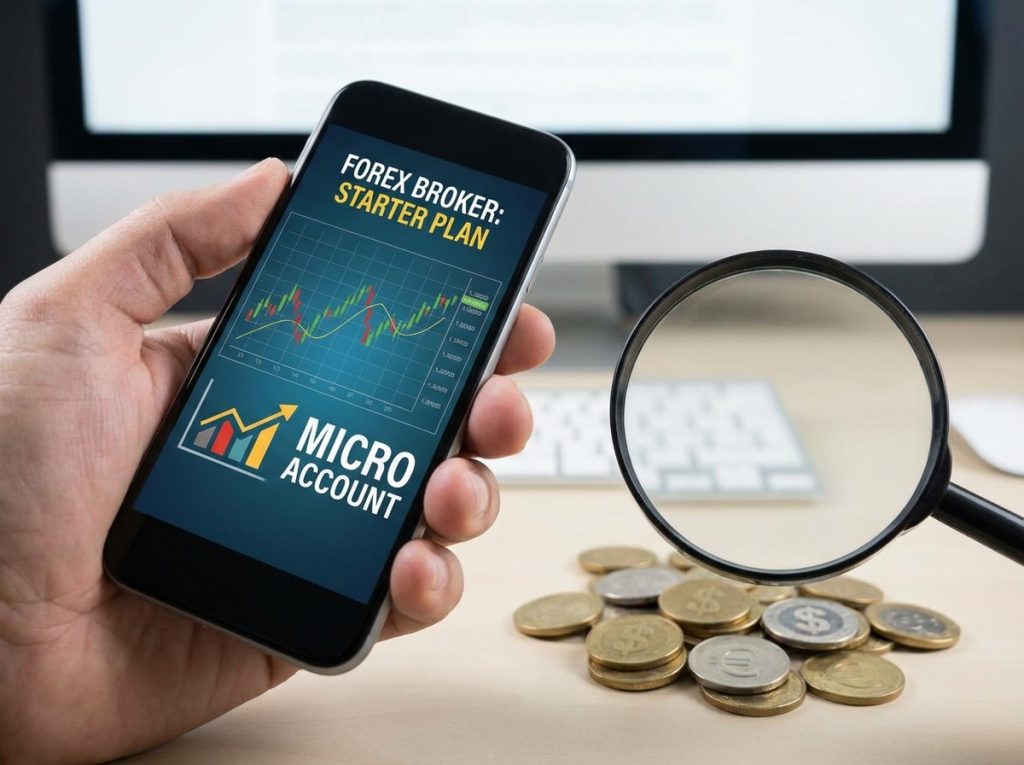
A micro account is a live trading account that lets you open very small positions, usually in micro lots of 1,000 units or in cent style accounts where the platform displays balances in cents. People chiefly use them to learn execution and emotional discipline with real fills, to test automated systems at low cost, or to fine tune position sizing without risking large sums. The advantage is lower absolute dollar risk. The downside is that very small trades can make spread and per trade costs proportionally larger, and some brokers route micro orders differently than standard accounts.
Micro accounts are chiefly designed for beginners who want live-market experience, but they are also used in certain other situations, e..g. by traders (regardless of experience level) who need to evaluate something, such as a new strategy or a new automated system. Traders developing or debugging algorithmic systems often need tiny live positions to test execution in real time, and micro or cent accounts are commonly offered by brokers precisely for EA testing. Experienced traders also use micro sizing to scale into or out of positions more smoothly, and to run portfolio-level risk controls that require many small, independent tickets rather than a handful of large ones.
Novices traders who want to experience live trading can benefit a lot from getting a micro account. With a micro-account, you do not need to risk a lot of money to get accustomed to things such as order entry, margin behavior, slippage, and the emotional effects of real profits and losses. Even with micro sized lots, you will learn how real market execution behaves. Demo accounts are great for leaning the platform, but fills are often idealized and you will not be emotionally invested. A real-money micro account reveals things such as slippage, partial fills, requotes, and how stops are handled under stress. A micro account exposes you to real-world mechanics with limited financial consequence.
Important: A broker can route micro orders differently than standard orders or aggregate them into internal pools. That difference can show up in various ways, and be especially problematic for scalping strategies and for EAs that assume uniform execution. If you test in a micro account, compare fills directly to small positions in a standard account or a regulated liquidity venue to confirm parity before you scale in any significant way.
In forex, a standard lot equals 100,000 units of the base currency. A mini lot is just 10,000 units and a micro lot is a mere 1,000. That makes one pip in a micro lot worth roughly $0.10 (for USD-quoted pairs) instead of $10 for a standard lot.
Brokers implement micro trading in two common ways:
Micro accounts reduce per-trade dollar risk, but in many cases the effective cost per unit of exposure is higher. Smaller accounts tend to produce lower absolute profits but the spread and commission as a percentage of a tiny position can be a larger share of expected move, and some cent/micro accounts apply wider spreads, higher minimum spreads, or different execution priorities (especially during news). If your micro account’s spread is substantially wider than the standard account’s spread, it becomes harder to be profitable. Always measure expected cost in dollars per pip at the trade size you will use. Back up any marketing claim with contract specs.
It is also important to be aware of the costs associated with deposits and withdrawals. Do you plan to make many small deposits? Do you plan to make many small withdrawals, instead of letting the account balance grow from the profits?
Some brokers charge processing fees that disproportionately affect low deposits and low withdrawals. There can also be minimum deposit and/or withdrawal thresholds. Read withdrawal terms, test small deposits and withdrawals early. Retrieving a $10 balance can become infeasible if the broker enforces a $50 minimum or charge $10 per withdrawal. Pick a broker where the rules align with your plan.
Micro accounts are usually a great choice when your objective is low-risk learning, testing execution, or validating a strategy or algo trading under live conditions with minimal capital. They are less appropriate when your goal is to test exactly how a strategy or automated trading will behave at standard trade sizes. Micro market structure and liquidity can differ materially from larger ticket trading and so performance often changes on scale. If you plan to scale up later, plan an explicit transition test. Allocate a small percentage of a standard account to simulate larger execution and compare fills before committing a significant capital increase.
Micro accounts are an effective, low-cost way to learn live forex mechanics, to test automated strategies, and to practice risk control. The advantage is real only when you use the account to answer operational questions, e.g. how stops execute, how fast fills arrive, how the broker treats your orders during news, and not as a way to avoid proper risk capital management. Vet the broker’s legal entity and execution terms, measure the actual dollar cost per pip at your intended trade size, and treat any profitable micro results as the first step in a careful scaling plan rather than as proof you should add bigger deposits and more leverage.
Which micro-account broker that is right for you will depend on several factors, including your trading plan, jurisdiction, and objective (e.g. learning live-markets vs. testing an algorithm). Don’t pick a broker solely on minimum deposit or a flashy cent-account marketing page. Pick based on your evaluation of the whole package, including everything from regulation and fee structure to execution and safety measures. Reputable brokers tend to publish these details clearly on their account specification pages. When you evaluate a broker, check the account specification page for things such as minimum lot, minimum deposit, spread types (fixed vs floating), commissions, and whether the cent/micro account is on the same execution servers and liquidity pools as the broker’s standard accounts. If it isn’t, you may be trading on different pricing and execution terms even though the interface looks identical.
Micro accounts are not a substitute for counterparty due diligence. You should verify regulation and reputation even if you only plan on making a small deposit. This process can be far from straight forward, since many brokers that offer cent/mini products operate through multiple legal entities in different jurisdictions. You need to know exactly which legal entity you will sign up with, where it is registered, and how it is regulated and licensed. To avoid jurisdictional complexity, it is usually best to pick a broker licensed in your home jurisdiction, unless your home jurisdiction is known to be lax when it comes to retail trader protection.
How well you will be protected depends a lot on the applicable jurisdiction and financial authority, since the rules vary a lot. A broker licensed by a financial authority such as ASIC in Australia or the FCA in the United Kingdom is controlled by much stricter trader protection rules than a broker based in a lax location such as the Seychelles or Vanuatu. Jurisdiction affects things such as money segregation, compensation schemes, dispute procedures, and recourse if something goes wrong. Confirm which legal entity will hold your account, where it is regulated, and what protection that regulation provides. If you are not a resident of this jurisdiction, confirm if you are still covered by compensation schemes, resource venues, etc. Read the small-print because it matters.
Do not take the broker´s information as gospel. Always verify all regulation and licensing claims directly with the regulator’s public register.
Do not pick a broker without knowing how well it fits your strategy when it comes to factors such as minimum lot size, how pip value maps to cents or base currency, spreads and commissions for the micro size and currency pair you intend to trade, whether the cent/micro account uses the same liquidity pool as larger accounts, and deposit/withdrawal rules and fees.
Technology matters too. Confirm the trading server and the trading platform. If you plan on accessing your account through a mobile device, make sure the app interface is suitable for your strategy and preferences.
You need to know the leverage and margin trading rules for your micro-account and your selected currency pair or pairs, and if the account will be covered by negative account balance protection.
Fast, competent support matters. When a fill or withdrawal goes wrong you may need rapid resolution. Make sure support is available 24/7 or 24/5 even for micro accounts. Check whether written trade logs are provided even for micro accounts and broker reputation when it comes to handling complaints from micro traders. Confirm the complaint escalation route and whether the broker is subject to an ombudsman or regulator who will adjudicate disputes.
Sticking to very small trade sizes is not a substitute for comprehensive risk management routines. As mentioned above, you need to verify that the broker is properly regulated and has a good reputation among micro-account holders before you proceed. You also need to develop a risk management routine with firm rules for your trading strategy. It will help you reduce the risk of wiping out your account, and it will also teach you sound risk management and how to stick to your own rules even when emotions are high. If you can´t stick to proper risk management in your micro account, expect to lose a lot of money once you transition into a standard account.
Fund the micro account only with money you can afford to lose, and treat the micro account as a testing lab and educational facility rather than as a tool for fast profits. Set fixed risk per trade in absolute currency units rather than as percent of a small balance, because percent-of-tiny-balance can encourage oversized relative risk. Use the broker’s smallest lot increment to learn the real dollar pip value and then size stops and position sizes accordingly. If you use automated systems, start with the fewest orders necessary to validate execution behavior and monitor for partial fills and rejected orders continuously. Keep a journal that records not only results but also execution anomalies and how you handles emotional pressure.
Brokers offering micro accounts often accept deposits as low as $5–$10, but that doesn’t change the need for proper risk management. Even if you only plan on depositing $5, it is still a bad idea to sign up with a broker that is not properly regulated, since it increases the risk of identity fraud. You will most likely be required to verify your identity even for a micro account, to comply with KYC and AML regulations. All the information you send to prove your identity can be used for identity theft if it ends up in the wrong hand, and you can lose significantly more than those $5 you deposited.
Regrettably, there are sketchy brokers (usually hiding out in lax jurisdictions) who have the patience to play the long-game. As long as you are in a micro account, making small profits, everything will run smoothly. Once you scale up and your account balance grows, you will run into some serious friction when it comes to actually withdrawing your money. All of a sudden, your account is frozen due to everlasting identity checks, alleged bonus requirements, or claims that you have violated some vague rule that does not even exist in your contract. Some fraudsters will even claim that it is out of their control and say that your account has been frozen by the local authorities due to suspected activities. If the local authority happens to be a super lax financial authority on a little paradise island on the other side of the world, recourse will be difficult, even if you can show you have not violated any rules. This is why you need be pro-active from the start and treat jurisdiction verification as a part of your risk management routine, even for micro accounts.
When it comes to scaling, do not play this by heart. The right way to do it is to carefully design a staged scaling plan that tests execution, and your psychological responses, at incrementally larger sizes. Do not assume linear scaling. Execute predefined test trades at 2x, 5x and 10x your micro lot size and compare slippage spreads and fills. If performance degrades materially as size increases, research and document the cause and adjust your sizing rules. Use profits to fund incremental increases rather than adding external leverage.
Regulation matters regardless of account size because using a broker that is not governed by a strict financial authority increases the risk of becoming the victim of fraud and similar financial crimes, including identity theft. It is also important, even for micro traders, to have recourse when a conflict with a broker can not be resolved without third-party intervention. Even when a trader starts out small, the plan is usually to scale with time, and you do not want to do this with an improperly regulated broker. Regulation impacts a wide range of things, including mandatory client money segregation, dispute resolution, and broker insolvency protections.
Before you sign up with a broker, verify the legal entity that will hold your funds, confirm that entity on the relevant regulator’s public register, and learn about the broker insolvency compensation rules. A broker that markets micro accounts and/or cent accounts globally will often operate through several legal entities. Make sure you are funding the entity that is regulated in the jurisdiction you prefer, not an offshore arm with weaker protections.
Minimum deposits vary widely, and some micro accounts allow deposits as low as a few dollars.
Do not look at minimum deposit only. It is important that a low deposit threshold also corresponds to an ability to actually make very small trades. Otherwise, you will not be able to stick to a sane risk management routine when it comes to trade sizing.
You must look at cost per pip at the trade size you intend to use. Some brokers widen spreads on micro accounts or charge higher commissions on small sizes so the effective cost per unit of exposure can be higher. Compute the dollar cost for a typical trade size in your micro account, include spread commission and any withdrawal fees, and compare that to a standard account at a small scaled size. Marketing slogans about tight spreads or zero commission trading can hide other charges, so run the numbers.
Be vigilant when it comes to how requotes, partial fills, slippage, and how stops are handled. If you pay attention, your micro account trading will reveal whether stops are converted to market orders and how the broker treats orders during volatility. Also be aware that some brokers have different routines for micro orders than for standard orders, and can for instance aggregate micro orders internally or pass them to a liquidity provider even when that is not the routine for standard size lots. Use your micro account with care to test execution under both routine and stressed conditions.
Read the account specification and the fine print and, if it’s not explicit, ask support for a clear statement. Does the cent or micro account share the same execution pool and price feed as standard institutional accounts? If they refuse to answer or provide vague marketing copy, treat that as a warning sign.
The practical test is to place identical small trades in both account types and compare fills, spreads and slippage across a handful of trades and across a news and a quiet period. Of course, this might not be feasible for a trader who needs a micro account because their budget is too small to fund and use a standard account.
News spikes tend to widen spreads and increase slippage everywhere. For micro accounts, the impact typically shows as abrupt negative P and L relative to quiet conditions because your stops may execute at much worse prices. Test your strategy across both quiet and news periods and size accordingly. Do not assume a normal spread will persist during the next scheduled release.
Do the calculation in units so you know real dollar exposure. A micro lot equals 1,000 units of the base currency. For a pair quoted to four decimal places like EUR USD one pip equals 0.0001. Multiply the micro lot size by the pip size to get pip value in quote currency. For EUR USD that is 1,000 times 0.0001 equals 0.1. So one pip with a micro lot is 0.1 USD. If the account currency differs convert that pip value at the current exchange rate to see true account risk.
A wide spread on a micro-sized trade is a much larger percentage drag than the same spread on a standard lot. Similarly, fixed commissions per trade can be proportionally large for small positions. Always compute expected cost in currency per pip for your typical micro position and include round trip costs in any edge calculation.
Many brokers permit leveraged trades and margin trading for micro accounts. Leverage percentages are typically the same across account types, but margin calls and forced liquidation rules depend on the broker’s policy. Small accounts can appear margin safe until a volatile move triggers a rapid equity drawdown. Always compute absolute dollar margin requirements at the micro size and model a worst case move to confirm you will not be force liquidated.
Yes. Negative account balance protection prevents you from owing more than your account balance, and this is important even for micro accounts. Some regulated entities include it as standard while others do not. In some jurisdictions, negative account balance protection is legally required for all retail accounts, including micro accounts.
If you plan on using leverage or margin, stick to brokers that will give your micro-account negative balance protection. Before your use any leverage or margin, make sure you understands the strings that come attached to the negative account balance protection.
Many brokers allow shorting and hedging in micro accounts, but you need to check the broker’s margin and hedging policies to know for sure. Some jurisdictions impose restrictions on simultaneous opposite positions or apply different margin rules. If your strategy requires hedging, make sure the micro account supports the exact order types and margin offsets you need.
Yes, they can be, depending on which broker you pick. Micro-accounts are commonly used to test algorithms in real market conditions at low cost, but confirm the broker supports, permits, and provide all the things your need for your specific strategy, e.g. the right order types, a stable VPS, and external VPS connections. Also check up the execution parity between micro and standard accounts. Automated systems can expose execution differences quickly, so start with tiny sizes and monitor for partial fills and server disconnects.
Note: Many brokers allow the use of MT4/MT5 Expert Advisors (EAs) in micro-accounts.
Cent accounts display balances and P and L in cents rather than units. It makes the arithmetic feel different (compared to a normal micro account) but does not change the underlying contract size. A cent account with a $10 deposit shown as 1,000 cents still uses the same tick and margin math. The difference is usually only cosmetic, but you should always check the fine print, e.g. because some brokers route orders from cent accounts to a different liquidity pool, and this can impact execution and pricing.
Examples of red flags:
Open a micro account with the minimum deposit, fund it, and run a short testing plan. Place a handful of typical trades in quiet market conditions and around a scheduled economic release. Test market and limit orders stops and scaling. Request a small withdrawal to confirm processing and costs. Compare execution with a demo and, if possible, with a standard account. Keep careful logs of fills spreads and any execution anomalies.
Some brokers allow cent or micro accounts to subscribe to signals or PAMM managers, but check whether the replication is precise and whether fees scale unfavorably. Copying a manager who trades larger sizes can lead to mismatched fills in your micro account. Verify the provider supports proportional scaling and run tests before committing capital.
There is no universal answer, but it is much easier to find market maker/dealer-desk brokers that offer micro-accounts. STP brokers and ECN brokers are more likely to focus on experienced traders who can afford to trade standard lots.
ECN or STP models that pass orders to real liquidity providers usually offer better pricing transparency than MM/DD brokers. You can expect tighter spreads, but higher commissions. If ECN or STP is important to you, make sure the ECN or STP model is actually used for micro orders. If micro orders are re-aggregated into an internal pool, you are not getting the normal STP or ECN experience. Verify actual trade reports and the venue your orders hit.
It is very important that you confirm the information directly with the broker before you make any decisions. Terms and conditions can change quickly, or vary depending on exactly which legal entity traders in your specific jurisdiction are signed up with.
Exness
XM
FBS
HotForex (HFM)
RoboForex
FXTM (ForexTime)
FXOpen
Pepperstone
A forex nano account is an account where you can trade nano lots, i.e. 100 units of the base currency. A forex nano account is basically a step below a micro account, and the nano accounts are appealing to traders who want to trade extremely small positions with very low capital. Nano accounts allows very small exposure per trade, which is ideal for learning strategies and managing risk with tiny accounts.
This is how the forex nano size compares with other lot sizes:
Example: If you trade USD/EUR in nano lots, one lot will be 100 units of the base currency, which means $100. The pip value is $0.01 per pip. If the exchange rate moves 10 pips, it is the equivalent of $0.10. If you were trading micro lots instead, one lot would be 1,000 units of the base currency, i.e. $1,000. If the exchange rate moved 10 pips, it would be the equivalent of $1.
Nano accounts are popular among beginners who want to practice with real money but very small risk per trade, and among traders who need to evaluate a new strategy. For a novice trader, the nano account can be a great first step, which can eventually lead to a micro account and then a standard account.
Nano accounts typically have very low minimum deposits, sometimes as little as $1-$5, depending on the broker.
Some brokers offer nano accounts for third-party platforms such as MetaTrader 4/5 (MT4/MT5), while others offer proprietary platforms.
Pros:
Cons:
It is very important that you confirm the information directly with the broker before you make any decisions. Terms and conditions can change quickly, or vary depending on exactly which legal entity traders in your specific jurisdiction are signed up with.
1. OANDA
Offers very small lot sizes (down to as little as 1 unit of the base currency in some cases) which makes granular position sizing possible. In some regions, you can deposit as little as $1.
2. FBS
FBS has cent accounts where nano lot trading is possible. The minimum deposit is $1 in some regions.
3. XM
The XM micro account lets you trade down to 0.001 lots (100 units) with a minimum deposit around $5, effectively giving nano lot level access.
4. RoboForex
RoboForex Pro Cent accounts allow nano lot style trading (0.001 lots) with low deposits ( $10). Multiple platforms (MT4/MT5/cTrader) available.
5. FXOpen
FXOpen offers micro accounts that support trading as low as 0.001 lots. Minimum deposit $1.
6. ITBFX
Offers a Nano Account where you can start trading with a minimum deposit of $10 and trade volumes starting at 0.001 lots (100 units).
7. Aron Groups
Has a Nano Account with a minimum deposit of $1 and nano sized trade volumes (0.0001–0.01 incremental).
8. TIOmarkets
Provides a Nano Account where you can trade from 0.001 lots (100 units). Minimum deposit $10.